
Posted By: The American Journal of Human Genetics, AJHG
Each month, the editors of The American Journal of Human Genetics interview an author of a recently published paper. This month, we check in with Samah to discuss her recent paper “Distinct cochlear cell types associated with genetic susceptibility to sensory and metabolic hearing loss in older adults.”
AJHG: What motivated you to start working on this project?
SA: This project grew naturally from our previous work showing that sensory and metabolic age-related hearing loss have distinct genetic profiles. We wanted to take the next step and ask whether these genetic differences could be linked to specific cell types in the cochlea. Integrating our genetic findings with single-cell data gave us an opportunity to explore the biology underlying these two forms of hearing loss in greater detail.
AJHG: What about the paper/project most excites you?
SA: What excites me most is that we were able to connect genetic susceptibility to specific cochlear cell populations. I was also particularly excited by what we observed when we looked within cell types and across age groups. To me, this highlights how much biological information can be missed when we treat a complex condition such as age-related hearing loss as a single phenotype.
AJHG: Thinking about the bigger picture, what implications do you see from this work for the larger human genetics community?
SA: Our findings emphasize the importance of phenotypic heterogeneity. Two individuals can both be described as having age-related hearing loss while the underlying genetic and cellular mechanisms may differ. This principle extends well beyond hearing loss and is relevant to many complex human traits and diseases. Better characterization of phenotypic subtypes, combined with cell-type-specific genomic data, may ultimately help us understand biological mechanisms with greater precision.
AJHG: What advice do you have for trainees/young scientists?
SA: Be willing to learn methods that are outside your comfort zone, and don’t be discouraged when an analysis does not give you the result you expected. Some of the most interesting parts of a project can come from trying to understand an unexpected result. I would also encourage trainees to focus on understanding the biological question rather than simply applying a particular method. Methods and technologies change quickly, but learning how to ask a good question, think critically about your results, and recognize the limitations of your data will always be valuable.
AJHG: And for fun, tell us something about your life outside of the lab.
SA: Outside the lab, I love spending time with my son and finding activities that we can explore together. I also enjoy organizing activities for children in my community. Recently, I’ve been rebuilding my reading habit in both Arabic and English, and I’ve also taken up swimming.
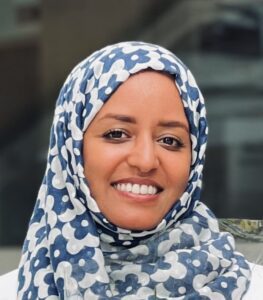
Samah Ahmed, PhD from the Department of Biochemistry and Medical Genetics at the Rady Faculty of Health Sciences, University of Manitoba.