
Posted By: The American Journal of Human Genetics, AJHG
Each month, the editors of The American Journal of Human Genetics interview an author of a recently published paper. This month, we check in with Alejandro to discuss his recent paper, “Using the ancestral recombination graph to study the history of rare variants in founder populations.”
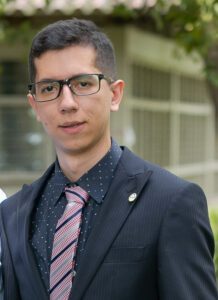
AJHG: What motivated you to start working on this project?
AM: During my undergraduate studies in Colombia, I started working on rare diseases, and we often found several patients carrying the exact same genetic variant. Several populations have experienced founder events, such as Quebec and Colombia. Founder variants are extremely important because they increase the frequency of rare diseases, which represent a burden for the healthcare system. We wanted to study these mutations using a systematic approach, leveraging haplotype sharing within carriers via the Ancestral recombination graph and the availability of large-scale biobanks as CARTaGENE.
AJHG: What about the paper/project most excites you?
AM: I am very excited about how the founder effect increases the statistical power to perform association analysis with rare variants. We demonstrated this with a pathogenic variant in the LPL gene, performing an association analysis with around 100 carriers. If we wanted a similar sample size elsewhere, we would have to combine several huge biobanks. Achieving this within a cohort of 30,000 participants is incredible.
AJHG: Thinking about the bigger picture, what implications do you see from this work for the larger human genetics community?
AM: I expect this work will change how we analyze founder mutations, providing a more systematic way to assess their importance for a specific population. Allele frequency estimation helps identify specific regions that could benefit from genetic screening for prevention, as we have done in the past in Quebec. One of the main messages of our work is that variants with high impact can also affect a significant number of individuals, especially in founder populations. I also want to encourage communities to reconstruct their genealogies, as it could be a more cost-effective approach to estimate regional frequencies, rather than sequencing everyone.
AJHG: What advice do you have for trainees/young scientists?
AM: Be passionate about what you do. If you care about your research topic, you will stay up to date in your field and propose new methods and hypotheses that could generate new knowledge. There is no easy path, so you must work hard. Finally, have brave ideas; a crazy thought could lead to a great discovery.
AJHG: And for fun, tell us something about your life outside of the lab.
AM: I enjoy playing volleyball and tennis during my free time. I use sports to distract myself and release stress. I work hard every day for my academic career, but I always find time to do things I like outside of the academic world. Having a work-life balance is key to success. I also enjoy rapping in Spanish.
Alejandro Mejia-Garcia, MSc, is a PhD student of Human Genetics at McGill University.