
Posted By: HGG Advances
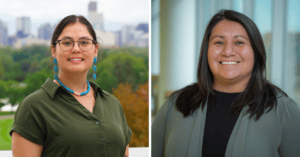
Each month, the editors of Human Genetics and Genomics Advances (HGG Advances) interview researchers who have published work in the journal. This month, we check in with Carissa Sherman and Betzaida Maldonado to discuss their paper “Underrepresented Voices in a Colorado Biobank: Perspectives from Focus Groups on Motivations, Return of Results, and Data Sharing.”
HGGA: What motivated you to start working on this project?
CS: When Katrina Claw, PhD, and Randi Johnson, PhD, MPH, reached out about this project, I was excited to learn more about the Colorado Center for Personalized Medicine Biobank on our campus. Being in the Claw lab, I have been part of research efforts primarily focused on Indigenous populations, including my own Tribe, Diné. Working with individuals from various backgrounds and identities provides greater insight into some of the similar motivators and barriers to participation in genetics research. Ultimately, I was motivated to see how our research efforts could support improvements in the experiences of historically underrepresented populations within biomedical research and biobanks.
BM: Soon after I noticed the underrepresentation of specific communities in genomics research during the first year of my PhD, I began thinking about barriers and challenges to participation, which I can relate to because of my own upbringing and identity as a first-generation Latina. For that reason, I was curious to learn more from the individuals who choose to provide their biospecimen for research. What motivates them, and what can we learn from them so that, as researchers, we can better engage others and increase representation in genomics research.
HGGA: What about this paper/project most excites you?
CS: I think there are two key things about this project that excite me. First, we have a diverse team of individuals coming from Indigenous, Hispanic, and queer backgrounds. We had participants connect with the research team because they ‘could feel it,’ feel the bond of having someone who is like you. By having individuals from backgrounds similar to our target population, we built trust and camaraderie in a short period of time. I am also personally interested in the “return of results” and thinking about the logistics of actually getting the results back to individuals. The return-of-results activity also helped identify potential areas of interest and ways to implement this process. There was a suggestion to develop an interface similar to food delivery apps that shows where your food is, but instead the interface follows your biospecimen, e.g., is it at collection? Analysis? Results in your UC Health chart or elsewhere? I think that would be a great tool!
BM: One of the aspects of this project that really excited me was the opportunity to interact with participants and provide an avenue for them to share their experiences. I was intrigued by their motivations for participation, and I learned how individuals weigh both benefits and risks when choosing to provide their biospecimen and participate. This balance is often shaped by participants’ unique identities and perspectives. The results from this study provide valuable insights for researchers seeking to develop more tailored and accessible recruitment strategies that can increase diverse representation not only in biobanks but also in study cohorts.
HGGA: What do you hope the impact of this work will be for the human genetics community?
CS: That is a big and important question. I hope that this work will benefit multiple parties of the genetics community. At the citizen level, participants identified that part of their participation was because there are not many people who look like them – I hope citizens continue to advocate for themselves and others in biomedical/genetic settings. At the researcher level, I hope this work conveys the importance of creating a diverse, inclusive team, piloting research efforts, and having a way to follow up and empower our participants in research.
BM: Even though most of my research is quantitative, I hope this project highlights the importance of mixed methods and qualitative research; they are so valuable. I am excited to share our findings and hope that it leads to more research that incorporates community engagement and diverse voices whenever possible. I also hope that others note that increased participant beneficence will improve research efforts and representation, ultimately providing researchers with a better understanding of how genetics impacts health outcomes.
HGGA: What are some of the biggest challenges you’ve faced as a young scientist?
CS: Some of the biggest challenges I’ve faced as a young scientist is finding ways to be myself and grow. Partly culturally and personality-wise, I’ve been described as quiet and reserved. In Diné, I was taught to listen first; at times, it feels like, as scientists, we’re pushed to have an answer and have an answer quickly. I’ve tended to need a bit more time to think and phrase my thoughts, and I’ve struggled with public speaking. I’ve become more comfortable navigating times to speak up and times to listen. My mentor, Dr. Claw, has been instrumental in supporting me in “going out of my comfort zone” in presentations and networking. Having a mentor from a similar background makes me think that I can do this (science) too!
BM: One of the biggest challenges I’ve faced as a young scientist is balancing different interests. As young scientists, some of us are eager to learn everything and become involved in multiple projects. While this is really helpful for building and expanding our skill sets, it can also be difficult to balance these interests and find the area of research and expertise that we want to grow in. Over time, with the support of my mentors, I’ve been able to better identify the area of research that most aligns with my interests and career goals.
HGGA: And for fun, what is one of the most fascinating things in genetics you’ve learned about in the past year or so?
CS: Aside from the Human Pangenome Reference Consortium, which is important to have representation of global human genomic variation, I would say the first federally funded Tribal data repository, “The Data for Indigenous Implementations, Interventions, and Innovations Tribal Data Repository.” This is an incredible advancement and exercise of Tribal and data sovereignty.
BM: Given my interests in population genetics and forensic science, I recently learned how a group of researchers at the University of California, Santa Cruz has been able to recover nuclear DNA from rootless hairs, a challenge that has limited the probative value of hairs collected from crime scenes. I enjoy seeing the interdisciplinary nature of how some problems can be addressed, in this case, applying knowledge from anthropology, ancient DNA, and computational biology to address a common problem in forensic genetics.
Carissa Sherman, PhD (postdoctoral fellow) and Betzaida Maldonado (graduate student) are trainees in the Department of Biomedical Informatics at the University of Colorado Anschutz.